

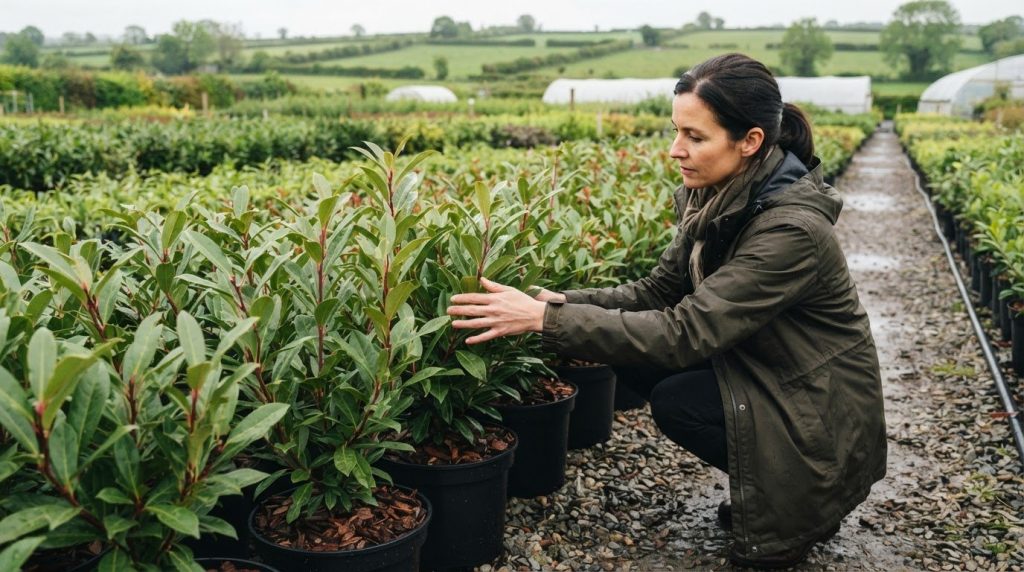
The slowest-growing hedge isn’t always the easiest fit: evergreen or deciduous makes a difference too. For year-round foliage, slow-growing holly or yew are options; choose a deciduous hedge if seasonal changes suit your garden. Beech grows at an approximate rate of 30–60 cm a year.
A hedge that needs less frequent trimming can save time, but growth rate is only one factor to consider. The available space, desired height and amount of winter cover you need all affect which plants will suit your garden.
This guide compares evergreen and deciduous choices, explains what to consider for maintenance, and covers planning hedge height and spacing. You’ll also find plant options for Irish gardens to help you choose slow growing hedge plants that suit your boundary and the time you can spend maintaining it.
Key Takeaways
- Choose evergreen holly or yew for foliage throughout the year, or consider deciduous beech if seasonal cover suits your garden.
- Compare growth rate and clipping needs before choosing; holly can stay neat with light pruning once or twice a year.
- Set your intended hedge height first, then use the plant’s mature spread to guide spacing and avoid overcrowding.
- Match plants to the conditions in your garden: yew needs well-drained soil, while other options suit different light and moisture levels.
1. Evergreen or deciduous?
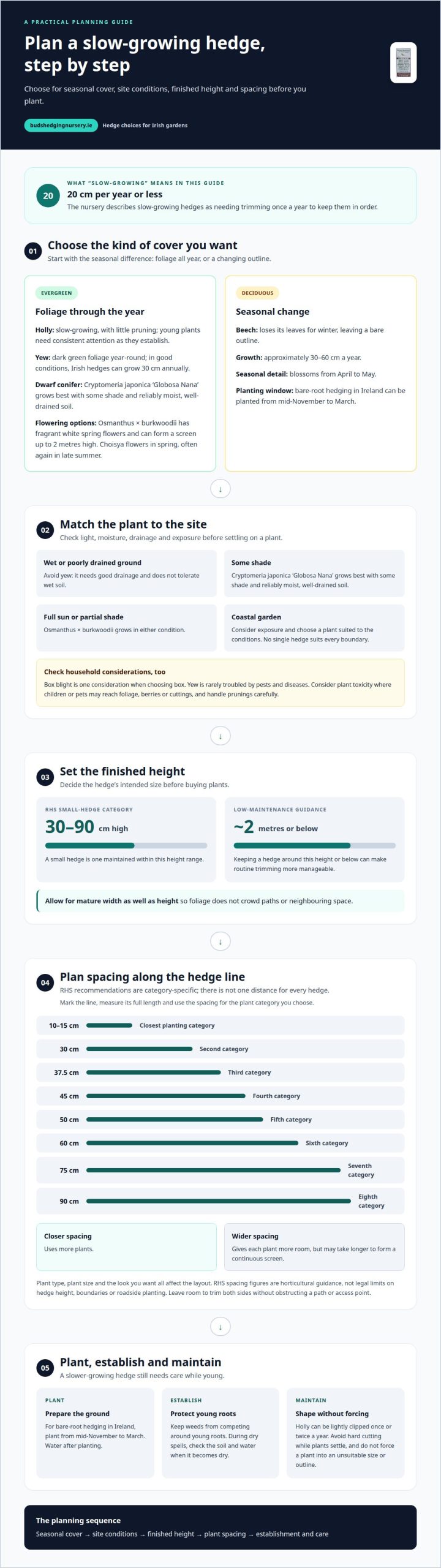
Start with the seasonal difference: evergreen hedges retain foliage, while deciduous plants lose it. Native holly is an evergreen choice that grows slowly and needs little pruning. It can take time to establish, so give young plants consistent attention as they settle. Yew also keeps dark green foliage through the year and grows more slowly than other conifers. In good conditions, yew hedges in Ireland can make 30 cm of growth annually.
For a compact evergreen, consider Cryptomeria japonica ‘Globosa Nana’, a slow-growing dwarf conifer that needs little pruning. It grows best with some shade and reliably moist, well-drained soil. Osmanthus × burkwoodii has compact growth and fragrant white flowers in spring. It can form a screen up to 2 metres high. Choisya keeps evergreen foliage and produces citrus-scented flowers in spring, often again in late summer.
Box, yew, holly and dwarf conifers don’t share one dependable annual growth rate. Yew can grow 30 cm annually in good conditions; box, holly and dwarf conifer growth varies with the plant and its growing conditions. Check the named variety’s expected mature size before planting, then compare its growth habit with your available space.
Choose deciduous beech if you prefer seasonal change and can accept a bare winter outline. Beech grows at an approximate rate of 30–60 cm a year and blossoms from April to May. For establishment, plant bare-root hedging in Ireland from mid November to March. Water after planting and keep weeds from competing around young roots. During dry spells, check the soil and water when it becomes dry. Avoid cutting hard while plants are settling; light shaping helps maintain a useful framework without removing too much growth.
2. Choosing slow-growing plants for low-maintenance hedges
Choose for manageable growth, not the smallest plant alone. The nursery’s description of slow-growing hedges is growth of 20 cm per year or less, with trimming once a year to keep them in order. Holly can stay neat with light clipping once or twice a year. A slower growth rate still needs attention: young plants need water while establishing, and weeds can compete with their roots. Match the hedge’s mature size to the boundary, so frequent corrective pruning isn’t needed.
In Ireland, plant costs vary by species, size and quantity. First measure the hedge and decide on spacing, then estimate how many plants you’ll need. Bare-root plants and larger, established specimens are different formats, so compare what suits your planting plan rather than choosing on size alone.
For shade, Cryptomeria japonica ‘Globosa Nana’ grows best with some shade and reliably moist, well-drained soil. Osmanthus × burkwoodii grows in full sun or partial shade. If the soil is wet, avoid yew, which needs good drainage and does not tolerate wet ground. In coastal gardens, consider exposure and choose a plant suited to the conditions. No single hedge suits every boundary.
The planting window for bare-root hedging in Ireland is mid-November to March. Plant into prepared ground and water well, then keep the root zone from drying out while plants establish. Holly can be lightly clipped once or twice a year to maintain its shape. Avoid forcing a slow-growing plant into a size or outline that does not suit its natural habit.
Box blight is one consideration when choosing box, while yew is rarely troubled by pests and diseases. Toxicity also matters, especially where children or pets may reach foliage, berries or cuttings. Identify plants before planting and handle prunings carefully. Choosing a hedge suited to its site, mature form and household needs can help reduce avoidable maintenance and safety risks.
3. Hedge height and spacing categories
Choose the finished height before buying plants. The RHS classifies a small hedge as one maintained at 30–90 cm. A low-maintenance hedge is ideally kept around 2 metres high or below. That height can make routine trimming more manageable, while still giving a clear boundary. Allow for the plant’s mature width too, so foliage doesn’t crowd paths or neighbouring space.
Spacing affects how quickly a hedge fills out and how much room each plant has to grow. The RHS recommendations cover these planting categories:
- 10–15 cm apart, the closest planting category.
- 30 cm apart, the second category.
- 37.5 cm apart, the third category.
- 45 cm apart, the fourth category.
- 50 cm apart, the fifth category.
- 60 cm apart, the sixth category.
- 75 cm apart, the seventh category.
- 90 cm apart, the eighth category.
The RHS spacing recommendations are category-specific, not a single distance for every hedge. Plant type, size and the look you want all affect the layout. Closer planting uses more plants; wider spacing gives each plant more room but may take longer to form a continuous screen.
For a boundary or roadside hedge in Ireland, consider ownership, visibility and access separately from planting distance. RHS spacing figures are horticultural guidance, not legal limits on hedge height, boundaries or roadside planting. Mark the hedge line carefully, and leave room to trim both sides without obstructing a path or access point.
First mark the hedge line and desired height. Measure the full length, then use the spacing chosen for the plant category to plan the layout. A small, clipped hedge, for example, may need a different arrangement from a taller screen. Planning ahead helps prevent overcrowding and makes future trimming easier.
4. What are the best slow-growing hedge plants for Irish gardens?
Match the plant to the hedge’s purpose, soil and available space. For a formal, dense evergreen screen, yew is a strong option. The RHS describes it as slower-growing than other conifers and suitable for formal hedging. In good conditions, Irish yew hedges can make 30 cm of growth annually. Choose well-drained ground, because yew doesn’t tolerate wet soil.
For a compact hedge with spring flowers, consider Osmanthus × burkwoodii. The RHS describes its growth as compact and slowish. It bears fragrant white flowers in spring and can form a screen up to 2 metres high. This makes it worth considering where a smaller evergreen boundary suits the garden better than a tall screen.
Choisya has evergreen foliage and citrus-scented flowers in spring, often flowering again in late summer. It grows in full sun or partial shade, so it can suit different garden positions. Choose it if you want seasonal flowers as well as year-round leaves, and prune to maintain your preferred shape and size.
For colour, slower-growing varieties of Berberis thunbergii can make distinctive hedges. Berberis thunbergii f. atropurpurea has purple foliage, yellow spring flowers and red berries in autumn and winter. Light pruning can keep berberis within bounds. Its seasonal detail can bring interest to a garden where a plain green boundary would feel too uniform.
The RHS describes Syringa meyeri ‘Palibin’ as a compact, slow-growing lilac that may suit a low, informal planting better than a clipped screen. Before choosing it, compare its mature form with your intended hedge height, then consider soil drainage and available light. These conditions help you narrow the options to plants suited to the site.
Explore hedge plant options as you compare suitable choices for your garden.
Choisya grows in full sun or partial shade, making it an option for a partly shaded site. Yew needs well-drained ground and is unsuitable for wet soil.
Buds Nursery Cavan: Portuguese Laurel
Buds Nursery Cavan offers Portuguese Laurel for gardeners planning a hedge. If you’re comparing evergreen options, consider it alongside Cherry Laurel and Golden Privet. Use your planned height, available space and preferred level of trimming to guide the choice. The right plant is one that suits your garden and the boundary you want to create.
Once you’ve narrowed down the kind of hedge you need, Buds Nursery Cavan can help you explore suitable plants. The nursery also offers fruit trees, which serve a different purpose from a boundary hedge. Keep your planting plan focused on the hedge’s function, then choose a plant suited to the site and the maintenance you’re prepared to manage.
Contact Buds Nursery Cavan to discuss Portuguese Laurel and other hedging options.
Turn your hedge plan into a planting choice
Before choosing slow growing hedge plants, decide what you need the hedge to do. A boundary, a privacy screen and a softer division between spaces may call for different plant forms. Keeping the purpose clear helps you choose for more than appearance alone.
Turn your plan into a shortlist by noting the site conditions, available space and level of maintenance that suits you. Compare each plant against those needs, and favour one that fits the garden naturally rather than one that needs constant trimming to stay in shape.
Buds Nursery Cavan offers Portuguese Laurel, Cherry Laurel and Golden Privet for hedging. Contact the nursery to discuss which option best suits your planting plan and garden requirements.
Contact Buds Nursery Cavan for hedge advice and take the next step towards a hedge that suits your garden.
Frequently Asked Questions
Evergreen or deciduous?
Choose evergreen plants if year-round foliage matters; holly and yew are examples for Irish gardens. Deciduous hedges lose their leaves for part of the year but can offer seasonal flowers or colour. Beech has a distinct seasonal outline, while Osmanthus × burkwoodii combines evergreen leaves with fragrant spring flowers. Consider winter screening, seasonal interest and the view beyond the hedge before deciding.
Which deciduous hedge plants are slow growing?
Syringa meyeri ‘Palibin’ is a compact, slow-growing lilac that may suit a lower, informal planting. Beech is another deciduous hedge option, although its approximate growth rate is 30–60 cm a year, so it isn’t as slow as ‘Palibin’. Choose beech for a more traditional clipped boundary; use the lilac where a compact form and spring flowers better suit the garden.
How far apart should slow-growing hedge plants be planted?
Use the plant’s recommended category rather than applying one spacing to every hedge. RHS guidance includes 30 cm, 45 cm and 60 cm apart for different planting categories. For example, a denser boundary may use closer spacing than a looser screen. Measure the hedge run, then calculate the plant count from the chosen spacing; include the end plants when marking positions.
How tall and wide do popular slow-growing hedge plants grow at maturity?
Mature size depends on the species, variety and pruning. Osmanthus × burkwoodii can form a screen up to 2 metres high, while a precise mature width isn’t provided here. Yew, holly and dwarf conifers also differ in their eventual spread. Before planting, compare the named plant’s mature dimensions with the space available, including room for growth on both sides.
How much do slow-growing hedge plants cost in Ireland?
In Ireland, costs vary by species, plant size and quantity. First work out the hedge length and spacing, then compare bare-root plants with larger, established specimens.
What are the best slow-growing hedges for shade, coastal gardens or wet soil in Ireland?
For a partly shaded site, Cryptomeria japonica ‘Globosa Nana’ suits reliably moist, well-drained soil, while Osmanthus × burkwoodii and Choisya grow in partial shade. Yew needs well-drained ground and does not tolerate wet soil. In coastal gardens, consider exposure and choose a plant suited to the conditions.