

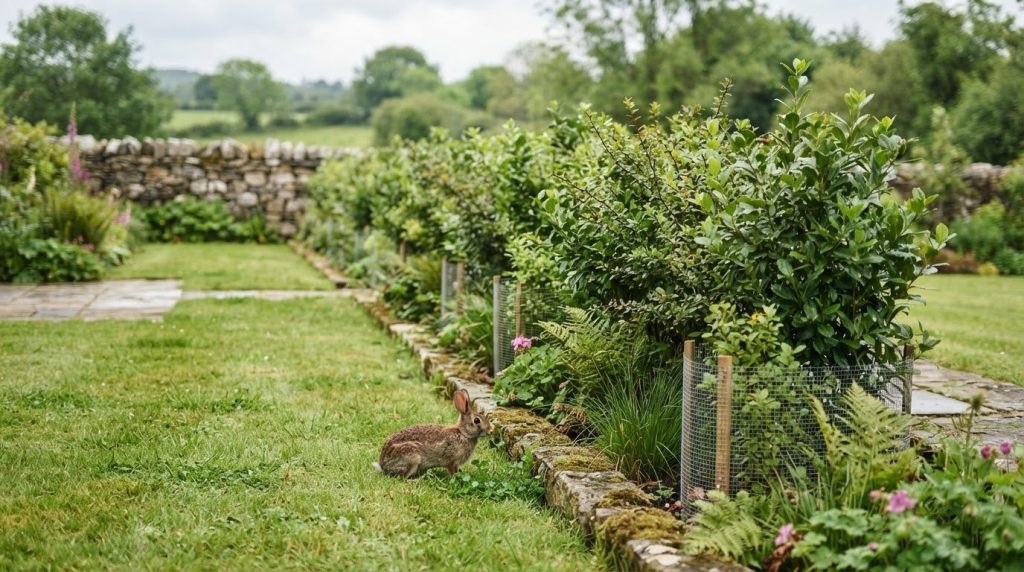
No hedge can make an unfenced garden completely rabbit-proof. Rabbit proof hedging plants can reduce the chance of damage, but rabbits may eat almost any plant when hungry, and young shrubs are especially vulnerable. For dependable exclusion, fencing is the effective barrier.
That doesn’t mean you have to fence the whole garden. Choosing less palatable hedge plants can help define a boundary while keeping the space open, provided you protect new growth as it establishes.
This guide explains which hedge plants may be less appealing to rabbits, what to consider in Irish garden conditions and how to protect young plants. It also covers where a hedge can help and where it cannot replace a physical barrier.
Key Takeaways
- Use protective netting around new planting or guards on individual shrubs to reduce damage while they establish.
- Match hedge choices to your garden’s soil, drainage, sunlight and exposure for stronger growth.
- Privet and Berberis are among the more rabbit-resistant hedge options, but no shrub is completely rabbit-proof.
- Consider evergreen choices for year-round cover, while remembering that plants alone cannot reliably exclude rabbits.
1. Landscape design tips for deterring rabbits
A hedge can shape a garden without protecting every boundary. However, no shrub is completely rabbit-proof, and hungry rabbits may eat almost any plant. They can also kill young trees, shrubs and flowering plants by grazing or damaging bark. Plan for protection while new growth is vulnerable, rather than relying on plant choice alone.
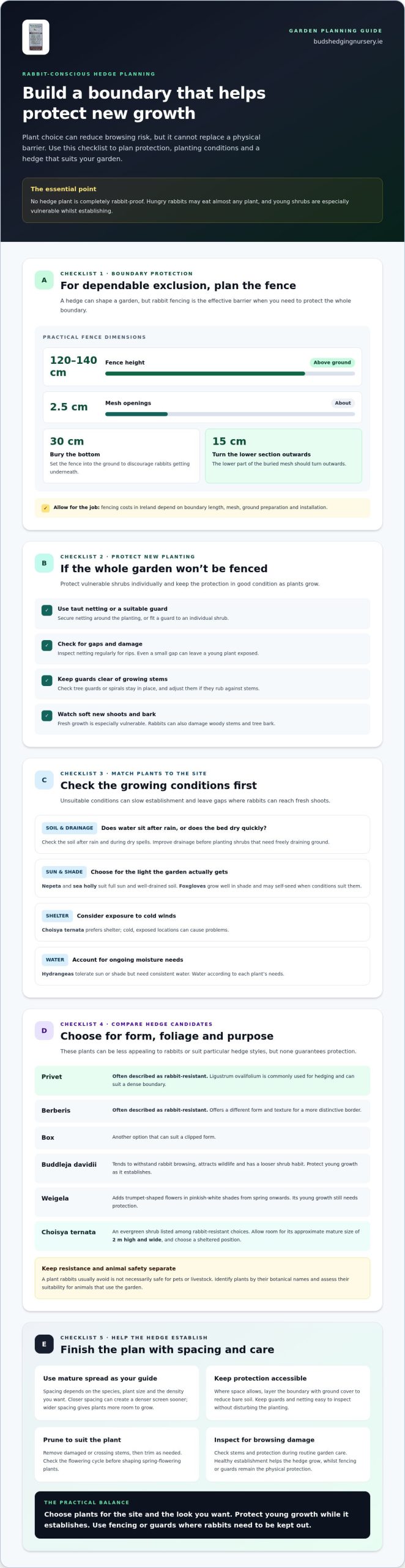
For a garden-wide barrier, use rabbit fencing with mesh openings of about 2.5 cm and a height of 120-140 cm. Bury the bottom 30 cm, turning the lower 15 cm outwards to discourage digging underneath. In Ireland, fencing costs depend on the boundary length, mesh, ground preparation and installation. These dimensions provide a practical starting point for planning the work.
If fencing the whole garden isn’t suitable, protect individual new shrubs with taut netting or a suitable guard. Secure netting around the planting and inspect it regularly for rips. Fit tree guards or spirals around individual woody stems, checking that they stay in place as plants grow. Adjust them if they rub against stems. Even a small gap can leave a young plant exposed.
Spacing depends on the hedge species, plant size and density you want. Use each plant’s mature spread as a guide: closer spacing can create a denser screen sooner, while wider spacing gives plants more room to grow. For example, space Green Privet according to its eventual shape and your desired hedge width, rather than applying the same distance to every variety.
Where space allows, design the boundary in layers. A hedge provides structure, while ground cover can reduce bare soil between shrubs. Keep guards and netting accessible so you can inspect them without disturbing the planting. Thoughtful spacing and physical protection help a new hedge establish, even where rabbits can reach other parts of the garden.
Site conditions such as soil, drainage, sunlight and exposure
Match each hedge plant to the available soil and light. Shrubs in unsuitable conditions may establish slowly and produce weaker growth, leaving gaps where rabbits can reach fresh shoots. Before planting, note whether the site stays wet, dries quickly, sits in shade or is exposed to cold winds. These details help narrow your choices.
Drainage matters to roots. Nepeta, a useful border companion, prefers full sun and well-drained soil. Sea holly also suits full sun and well-drained ground. These examples show why one planting mix won’t suit every plant. If water sits on the soil after rain, improve drainage before choosing shrubs that need freely draining ground.
Light and exposure can rule out otherwise suitable choices. Foxgloves grow well in shade and may self-seed when conditions suit them. Choisya ternata prefers shelter, as cold, exposed locations can cause problems. Hydrangeas tolerate sun or shade but need consistent water. Choose plants for the actual conditions, not just the hedge’s appearance.
Soil moisture also affects establishment. Check the bed after rain and during dry spells, then water according to the plant’s needs. In a sunny, free-draining border, Nepeta is a better fit than a shade-loving plant. In a sheltered position, Choisya may suit better than in an exposed corner. These choices support healthy growth, but they do not prevent browsing.
Pruning needs vary by species and the shape you want. Follow the plant’s growth habit: remove damaged or crossing stems, then trim as needed to keep the hedge tidy. Don’t treat every shrub alike. A spring-flowering plant, for example, may need different pruning timing from one grown mainly for foliage. Check its flowering cycle before shaping it.
Where bare soil needs covering, ground cover plants can complement a hedge. Keep their light and drainage needs in mind too. A suitable match helps the planting establish, whilst fencing or guards remain the physical protection for vulnerable shrubs.
3. Plant choices for hedges
Rabbits graze a wide range of garden plants, including young shrubs, trees and herbaceous growth. Soft new shoots are particularly vulnerable, so even resistant plants need protection whilst establishing. Bark damage matters too: if rabbits remove bark around a tree trunk’s full circumference, the damage, called ringbarking, can kill it.
Privet and Berberis are practical hedge candidates often described as rabbit-resistant. Ligustrum ovalifolium is a privet commonly used for hedging, while Berberis offers a different form and texture. Box is another option. Compare mature shape, foliage and the look you want before choosing plants. No shrub is completely rabbit-proof.
Buddleja davidii is another shrub that tends to withstand rabbit browsing and attracts wildlife. Weigela offers trumpet-shaped flowers in pinkish-white shades from spring onwards. These choices add flowering interest, but their young growth still needs protection. Aromatic plants shouldn’t be treated as a barrier for neighbouring shrubs. Rabbits can reach and browse plants beyond them.
Rabbit resistance and safety for pets or livestock are separate concerns. Don’t assume a plant is safe for animals because rabbits usually avoid it. Identify plants by their botanical names, then assess their suitability for the animals that use your garden. This is especially important where animals can reach leaves, stems or fallen plant material.
Choose a hedge for its role as well as its resistance. For a dense boundary, consider privet; for a more distinctive border, consider Berberis. Box can suit a clipped form, while Buddleja davidii has a looser shrub habit. Match your choice to the available space and garden conditions. Protect new plants from browsing as they establish, and check stems for damage during routine garden care.
Rabbits may browse young shrubs and trees, especially their soft new shoots, and can damage tree bark. Even resistant hedge plants may be vulnerable while they establish.
4. Are any rabbit-proof hedging plants evergreen and suitable for Irish gardens?
Yes, some evergreen shrubs can suit a garden boundary, but none is completely rabbit-proof. Choisya ternata is evergreen and is listed among rabbit-resistant shrubs. It grows to approximately 2 m high and wide, so allow room for its mature spread when positioning it. Its strongly scented foliage and summer flowers also add interest beyond winter cover.
Choose the planting position carefully. Choisya can struggle in cold, exposed locations, so place it in a sheltered part of the garden. Check how wind reaches the boundary and whether walls or established shrubs offer shelter. In an exposed spot, another plant may suit better. Rabbit resistance doesn’t remove the need to protect young growth.
Aucuba, also called spotted laurel, is another evergreen option for shaded gardens. It can provide foliage through the year where direct sunlight is limited. Consider it for a mixed planting rather than assuming it will form a clipped hedge. Allow for its eventual spread and leave space for neighbouring plants.
For Irish gardens, weigh evergreen cover against exposure, drainage and available space. A sheltered position suits Choisya better than a cold, exposed corner, while a shaded border may suit Aucuba. These differences matter when choosing plants for a boundary that needs winter foliage. Protect newly planted shrubs until their growth is established.
Evergreen leaves don’t make a hedge an effective rabbit barrier. Rabbits can still browse young shoots, and hungry animals may eat a wide range of plants. Use guards or fencing where browsing threatens the planting. Check lower stems regularly, as damage can be easy to miss beneath dense foliage.
To compare evergreen choices for your boundary, explore evergreen hedge plant options and consider the site conditions before deciding. A well-matched shrub can provide lasting structure, whilst practical protection helps it establish.
Buds Nursery Cavan: Portuguese Laurel
Buds Nursery Cavan offers Portuguese Laurel for gardeners planning a hedge in Ireland. If you’re choosing plants for an unfenced garden, consider the soil, light and exposure alongside the hedge’s purpose. No shrub is completely rabbit-proof, so plan protection for young plants as they establish.
Portuguese Laurel is one option to compare with Cherry Laurel and Golden Privet. Consider the foliage and boundary style you want, then match your choice to the growing conditions. A suitable plant can provide structure, but it shouldn’t replace guards or fencing where rabbits are damaging new growth.
For help exploring these hedge plant options, contact Buds Nursery Cavan.
Plan a hedge that suits your garden
Before buying, decide what the hedge needs to do: mark a boundary, soften a view or provide structure through the year. Then consider how much trimming and protection you can manage as plants establish. This gives you a practical basis for choosing rabbit proof hedging plants without expecting them to form an impenetrable barrier.
Sketch the proposed hedge line and note changes in light, shelter and soil along it. This can help you compare plants and avoid treating a long boundary as one uniform planting. Buds Nursery Cavan offers Portuguese Laurel, Cherry Laurel and Golden Privet for gardeners considering hedge options.
Take your preferred hedge style and garden conditions into account as you decide what to plant. Contact Buds Nursery Cavan for plant advice and take the next step towards a boundary that works for your garden.
Frequently Asked Questions
Can I create a garden without fencing the entire site?
Yes. You can leave most of the garden open and protect specific areas instead. For example, use a small fenced enclosure around a vegetable bed or guards around newly planted hedge sections. This focuses protection where browsing would cause the most damage. Choose the protected area based on rabbit access and the plants you most want to protect.
Which hedge plants are most resistant to rabbits in Ireland?
Privet, Berberis and Box are among the more rabbit-resistant hedge choices. Green Privet offers a straightforward hedge option, while Berberis suits a more varied boundary. Treat “resistant” as a relative description, not a guarantee. Rabbits can browse young growth, so protect new plants instead of relying on a plant’s reputation alone.
Which native Irish hedge plants are rabbit-resistant?
Whitethorn is a native hedge choice, but no native plant should be assumed to be rabbit-proof. Young plants and soft new growth remain vulnerable, even when mature shrubs are less appealing to rabbits. If you choose a native hedge, plan how to protect it as it establishes. A mixed hedge also offers flexibility in form and seasonal interest.
How can I protect newly planted hedging from rabbits?
Protect each exposed plant with a secure guard or surround the new hedge run with taut netting. Check regularly for gaps, loose sections and rubbing against stems. Inspect the barrier after strong winds or garden maintenance, and reposition it where needed. Keep it clear of new shoots so it protects the plant without pressing on its growth.
Where can I buy rabbit-resistant hedging plants in Ireland, and what are typical prices?
Buds Nursery Cavan sells hedge plants including Portuguese Laurel, Cherry Laurel and Golden Privet. Contact the nursery on +353 87 2686598 for current prices, as no typical price range applies across different plants. Delivery service is available pending quantity and site location. Choosing a plant suited to your boundary and garden conditions is a useful starting point.
Which hedge plants do rabbits commonly eat or damage?
Rabbits may browse almost any hedge plant when hungry, especially young shrubs with soft new shoots. Even resistant choices such as privet and Berberis can be damaged while establishing, and rabbits may strip bark from woody plants.