

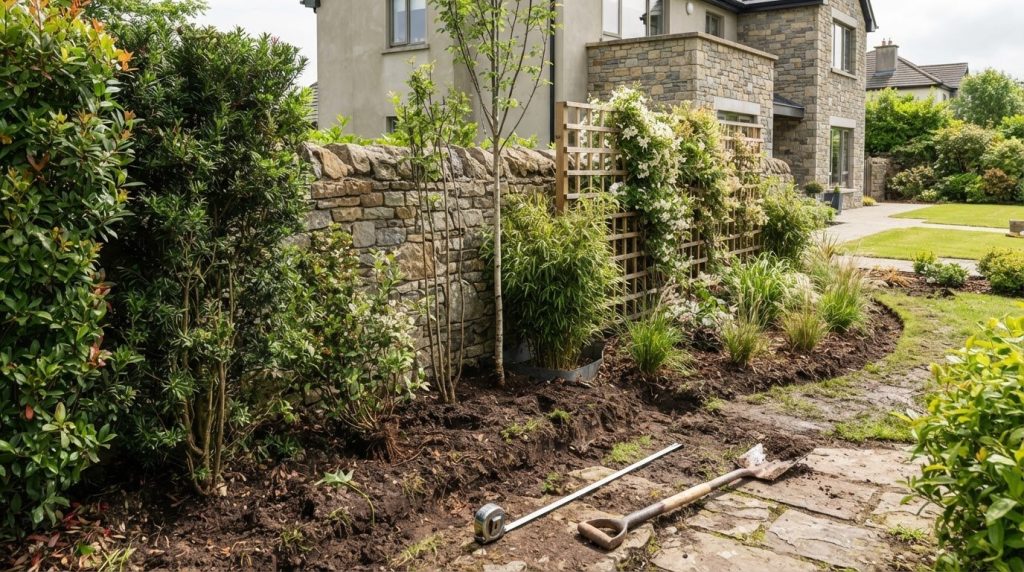
The quickest-looking screen isn’t always the cheapest choice. The practical answer to how to create garden privacy quickly is to choose established shrubs or trees at a height that suits the boundary and your budget. Instant hedging can be supplied at 1.5-2 metres tall, saving 3-5 years of growing time compared with planting bare-root hedges.
It’s understandable to focus on the price of the plants, but the total cost also depends on how much screening you need, the condition of the soil and any preparation required. A fast-growing option may fill a gap sooner, while a slower-growing hedge can suit a longer-term plan. This guide compares shrubs and trees for privacy, explains how soil, planting height and seasonal growth affect the result, and sets out what to consider when weighing costs. You’ll be able to narrow the options to a screen that fits your garden and the level of privacy you need.
Key Takeaways
- Match screening plants to your soil, exposure and required height before comparing options; these factors affect both establishment and long-term upkeep.
- For a faster hedge, compare established plants with bare-root choices: instant hedging can save 3-5 years of growing time.
- Use climbers or ornamental grasses where you want a lighter, seasonal screen or have limited ground space.
- Clump-forming bamboo can provide height, but plan for root control if planting it in the ground.
- Evergreen shrubs and trees can help maintain privacy through the seasons; consider mature size and the amount of screening needed when choosing.
1. Choosing screening plants for soil and required height
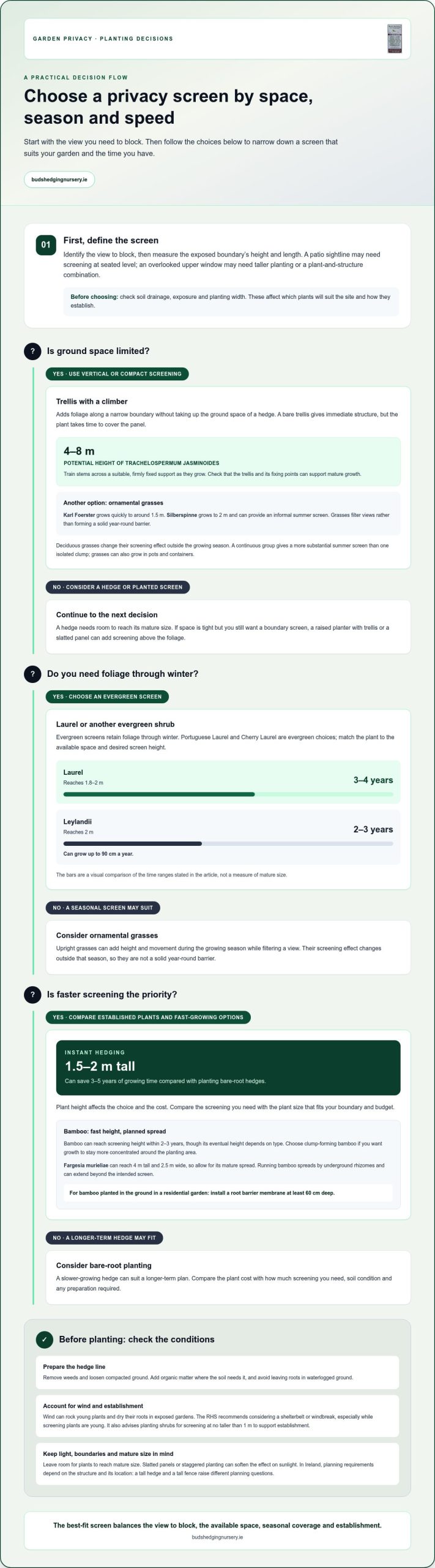
Start by identifying the view you need to block, then measure the height and length of the exposed boundary. A screen beside a patio may need to block sightlines at seated level, while an overlooked upper window calls for taller planting or a combination of plants and a structure. Soil drainage, exposure and planting width also affect which plants are suitable.
For a quicker hedge, laurel can reach 1.8-2 metres in 3-4 years; Leylandii can reach 2 metres in 2-3 years and grow up to 90 centimetres a year. Bamboo can reach screening height within 2-3 years, though its eventual height depends on the type. Portuguese Laurel and Cherry Laurel are evergreen options; choose to suit the space and desired screen height.
Before planting, remove weeds and loosen compacted ground along the hedge line. Improve the planting area with organic matter where the soil needs it, and avoid leaving roots in waterlogged ground. In exposed gardens, wind can rock young plants and dry their roots. The RHS recommends considering a shelterbelt or windbreak to protect screening plants, especially when they’re young. It also advises planting shrubs for screening at no taller than 1 metre to support establishment.
Evergreen screens retain foliage through winter, while deciduous choices open the view seasonally. For a layered screen, place taller shrubs behind lower ground cover, leaving enough space for plants to reach their mature size. A raised planter can define a boundary where ground space is limited; combine it with trellis or a slatted panel to add screening above the foliage without building a solid wall. Consider planting height and position so the garden still receives useful light.
In Ireland, there isn’t one height rule that automatically applies to every fence, boundary wall and hedge. Planning requirements depend on the structure and its location, so distinguish planted screening from a built boundary screen and consider the site before choosing a height. A tall hedge and a tall fence raise different planning questions.
To install a freestanding screen, mark its position, check that the base will sit securely, then anchor the supports before fixing the panels. Keep the screen within your boundary and use a slatted design or staggered planting to soften its effect on sunlight and neighbouring gardens. A trellis with climbers can create a greener, less enclosed finish than a solid panel.
2. Climbers on trellis and ornamental grasses
A trellis with climbers adds foliage along a narrow boundary without taking up the ground space of a hedge. It can soften an existing fence and break up direct views while leaving gaps for light and airflow. Choose the trellis position first, then match the climber to the exposure and height you need. A bare panel provides immediate structure, but the plant takes time to cover it.
Trachelospermum jasminoides is a vigorous twining climber that, according to the RHS, can reach 4-8 metres in height. Train its stems across a suitable support as they grow, rather than expecting a newly planted climber to screen the whole panel straight away. Before planting, check that the trellis is firmly fixed and can support the mature growth. A trellis attached to a fence also needs sound fixing points.
Ornamental grasses offer a different kind of screen. Calamagrostis x acutiflora ‘Karl Foerster’ grows quickly to around 1.5 metres, while Miscanthus sinensis ‘Silberspinne’ grows to 2 metres and can provide an informal summer screen. These upright forms suit a border where you want to filter a view, rather than create a solid year-round barrier. Pink pampas grass, Chinese silver grass, New Zealand flax and flax lily are other options to consider.
Season matters. Deciduous grasses can provide height and movement during the growing season, but their screening effect changes outside it. For a more substantial summer screen, plant grasses in a continuous group rather than relying on one isolated clump. If planting space is limited, ornamental grasses can also grow in pots and containers. Container size and position affect how the planting fits the boundary and how easily it can be moved.
Compare the full setup, not just the plant. A trellis and climber require a suitable support, whilst a planter adds a container and growing medium. Plant size, panel material and the number of plants all affect the outlay. A simple approach is to cover the main sightline with trellis, then use lower planting to soften its base. Ground cover plants can help fill that lower layer without adding another tall screen.
Leave room to reach the fence for maintenance, and guide new stems across the trellis rather than letting them bunch at the base. In a small garden, use a slatted panel with grasses in front; along a longer boundary, repeat climbers and grass groups for more even coverage. These combinations provide privacy without making the whole garden feel enclosed.
3. Clump-forming bamboo and root barriers
Bamboo can form a tall, leafy screen faster than a traditional hedge. It can reach screening height within 2-3 years, but height and spread vary by type. Fargesia murieliae can reach 4 metres tall and 2.5 metres wide, so allow space for its mature growth. That spread matters beside paths, fences and other garden structures.
Choose clump-forming bamboo when you want growth to stay more concentrated around the planting area. Running bamboo spreads by underground rhizomes and can extend beyond the intended screen. This is a key risk with fast-growing privacy plants: roots may spread into nearby ground, while rapid top growth needs regular management. A laurel hedge avoids bamboo’s rhizome issue, but still needs room to grow and trimming to maintain its shape.
For bamboo planted in the ground in a residential garden, install a root barrier membrane at least 60 cm deep. Plan its route before digging, so the barrier encloses the planting area without gaps. Join the ends securely, then inspect the boundary as the bamboo grows. A barrier limits rhizome spread; it doesn’t remove the need to monitor the planting and manage growth.
Container planting offers another way to limit spread. A large, stable planter can position bamboo beside a patio or along a boundary where open ground is limited. Check that the container drains well and has enough room for the plant’s root ball. As the screen grows, watch for roots emerging through drainage openings or shoots appearing outside the intended area.
Match the bamboo’s eventual height to the view you need to screen. A tall clump may suit an overlooked upper window, while a lower screen can preserve light across a small garden. Place taller bamboo behind lower planting rather than lining every boundary with dense growth. Laurel hedges and other shrubs can form a softer layer nearby, but avoid crowding their canopies or restricting access for maintenance.
Before planting, mark the screen’s position and check where its mature width will sit. Keep access clear for removing dead canes and controlling new growth. In an exposed garden, young bamboo may need protection from strong winds while establishing. A fence or trellis can provide a separate visual screen during that time, but position it so maintenance remains practical.
Bamboo suits a garden where its spread can be contained and its growth monitored. Choose another screen if the planting area cannot accommodate a barrier or regular upkeep. Along a long, narrow boundary, a laurel hedge may be easier to shape; in a compact corner, contained bamboo can provide height without forming a continuous hedge.
4. Evergreen shrubs and seasonal privacy
Evergreen shrubs keep their foliage through winter, making them useful when a garden needs screening throughout the year. Green Privet is one hedge option; choose its position according to the sightline, available ground and desired mature size. A continuous hedge gives a more uniform screen, while mixed shrubs create a softer boundary with varied leaf shapes and textures.
Seasonal screening may suit a garden where winter light matters. Deciduous shrubs lose their leaves, so they provide less visual cover in colder months but let more light through. Carpinus, or hornbeam, is deciduous and holds its dead leaves in winter. This can provide partial screening beyond the growing season, although it won’t look like a fully evergreen hedge.
Yew offers a long-term evergreen choice, but it can take 5-7 years to reach a useful screening height. Compare that timescale with your need for privacy before planting. If the view needs covering sooner, combine shrubs with a trellis or another suitable structure, then let the planting develop around it. This avoids relying on a young hedge to provide full cover immediately.
Layering helps screen different sightlines. Place taller shrubs towards the boundary and lower plants in front, keeping access clear for trimming and watering. Ground cover plants can soften the base and reduce bare soil, while perennials add seasonal foliage or flowers without becoming the main privacy screen. Leave enough space between layers for light and air to reach the plants.
For a practical layout, mark where the view enters the garden before buying plants. Check the sightline from the patio, kitchen window and seating area, then place evergreen shrubs where screening matters most. Use deciduous planting where winter light is useful. A staggered arrangement can cover gaps more effectively than a straight line, provided mature plants have room to grow.
Seasonal upkeep affects how well the screen performs. Check for gaps as shrubs grow, remove dead or damaged branches, and trim to maintain the intended shape. Avoid cutting every plant to the same height if the boundary needs a varied canopy. In exposed areas, young screening plants benefit from protection while establishing; the RHS recommends considering a shelterbelt or windbreak at exposed sites.
For a year-round boundary, evergreen shrubs are the stronger choice. For a lighter, changing screen, combine deciduous shrubs, perennials and ground cover. Green Privet can form the evergreen layer, while lower planting softens the hedge’s edge and gives the garden a more varied finish.
5. Using shrubs and trees for privacy
Shrubs and trees can screen a boundary while adding foliage, seasonal colour and a garden feature. Start by identifying the sightline, then choose a plant whose mature height and spread suit the available space. A tree that grows too wide can crowd a path or neighbouring planting, even if its canopy blocks the view.
For evergreen screening, Photinia × fraseri ‘Red Robin’ can reach 4-6 metres tall. Its foliage provides year-round cover, with red new growth adding colour. Deciduous Amelanchier lamarckii also reaches 4-6 metres, but its screening changes with the seasons. It can suit a garden where a useful winter view or extra light matters more than continuous cover.
Consider the sightline before choosing a standard tree. A clear stem of at least 1.5 metres can lift the canopy above a seating area, leaving the ground beneath open for lower planting. This approach suits a garden where a solid hedge would take too much width. Layer ground cover below the tree to soften the base and fill the space without hiding the trunk.
Pleached trees create a defined screen above a clear stem. Pleached Carpinus can help define a garden boundary while keeping the space beneath the canopy more open. Although deciduous, it holds dead leaves in winter, providing some seasonal cover. Evergreen pleached screen options include holly, Portuguese Laurel and Photinia ‘Red Robin’.
Allow space for mature growth. Magnolia grandiflora can reach 6-18 metres in height and 15 metres in spread, which makes it unsuitable for many narrow boundaries. Malus ‘Evereste’ reaches 7 metres tall and 6 metres wide, whilst Pyrus salicifolia ‘Pendula’ reaches 5 metres tall. Compare those dimensions with fences, paths and neighbouring canopies before planting.
For a layered boundary, place taller shrubs about 1 metre from a fence or wall. This leaves room to maintain the planting and helps prevent foliage pressing against the structure. Planting screening trees at 1.8 metres supports establishment, according to the RHS. Bare-root trees can suit a planned hedge or mixed screen, while instant hedging can provide plants already 1.5-2 metres tall.
Choose trees for the height and form the garden needs, not simply their speed of growth. If you’re planning a mixed screen, explore bare root trees as one option for establishing a planted boundary.
Buds Nursery Cavan: Portuguese Laurel
Buds Nursery Cavan offers Portuguese Laurel for gardeners choosing an evergreen boundary screen. Cherry Laurel and Golden Privet are further hedge options to compare with your garden’s space, soil and screening needs. If you’re planning a mixed boundary rather than a continuous hedge, Fruit Trees may suit a separate part of the garden.
Turn to Buds Nursery Cavan when you’ve settled on the type of planting and want to explore these options for your garden. Consider the sightline you need to screen and the room available for the plants as they grow. For more information about the nursery’s planting options, visit budshedgingnursery.ie.
Choose a screen that fits your garden
Planning how to create garden privacy quickly starts with deciding which view to screen and how much space you can give to planting. A boundary should work with the garden, not simply fill it. Consider whether you want year-round foliage, seasonal light or a natural feature that leaves room for other planting.
If you’re ready to choose hedge plants, Buds Nursery Cavan offers Portuguese Laurel, Cherry Laurel and Golden Privet. These provide a practical starting point for planning an evergreen or mixed boundary. Note your soil, exposure and available planting width before settling on a plan.
A considered choice can make the garden more private whilst keeping it useful and welcoming. For a next step, contact Buds Nursery Cavan for planting advice and discuss which of these hedge options suits your plans. With the right screen in mind, you can move forward with confidence and make better use of your garden.
Frequently Asked Questions
How much does it cost to get privacy in an overlooked garden?
The cost depends on the area to screen, the required height and the materials or plants chosen. A short section beside a seating area calls for a different approach from a long boundary. Soil preparation, containers and supports can also affect the total. To plan a workable budget, measure the exposed area first, then compare a temporary screen with a planted solution and include any maintenance materials.
What are the quickest ways to add privacy to a garden?
For immediate cover, use a freestanding screen or add a suitable trellis panel to an existing fence. Plants create a softer finish but need time to fill gaps. A practical plan for how to create garden privacy quickly is to identify the main sightline, screen that spot first, then add planting around it. This focuses the initial work on the areas that are actually overlooked.
How can I create instant garden privacy with screens or fencing?
Position a screen across the direct view from an overlooking window or neighbouring garden, rather than closing off the whole boundary. For a freestanding panel, assemble its supports on stable ground and secure it before adding climbing plants. Check its position from inside the garden, including from the seating area. A slatted or trellis-style design can interrupt sightlines while reducing the sense of enclosure.
How much do garden privacy screens, fences, and instant hedging cost in Ireland?
There isn’t one set cost for these options: dimensions, material, plant size and boundary length all affect the total. A screen’s cost depends on its construction and size; fencing costs also vary with materials and work involved. Instant hedging costs depend on the plants and quantity selected. Compare estimates on the same basis, including supports, ground preparation and delivery where relevant, rather than comparing headline figures alone.
How can I add privacy to a rented garden without permanent changes?
Use movable items that don’t require digging or fixing into a wall, fence or paving. A freestanding screen, trellis held in a stable planter or container-grown shrubs can be repositioned as needed. Group containers around the seating area to block a specific view, and keep access routes clear. Before attaching anything to the property or altering a boundary, agree the change with your landlord.